One Encounter One Chance

ONE ENCOUNTER, ONE CHANCE
The Essence of the Art of Karate
  • Book Reports
  • Book Reviews
  • Author's Commentary
"One Encounter, One Chance is terrific. It is one of the highest quality and integrity and it speaks eloquently to moral and ethical concerns."

—George Leonard, Contributing Editor, Esquire, and author of
Walking on the Edge of the World, The Silent Pulse,
The Transformation, and Mastery

Benjamin Franklin Award Winner for Excellence in Independent Publishing

This book takes a fresh look at the traditional principles of Karate, and especially a concept fundamental to all martial arts—that of the "empty self." It asks readers to let go of preconceptions of Karate as merely a system of self-defense techniques and to realize the true intentions of this remarkable martial art: a means for self-understanding and for peaceful resolution of conflict.

Dr. Terrence Webster-Doyle is a martial arts sixth-degree black belt, former school teacher and administrator, Juvenile Delinquency Prevention Commission task-force member, and the co-parent of five daughters. For more than forty years, Dr. Webster-Doyle has trained in and taught martial arts internationally. He has written eighteen internationally acclaimed, award-winning books on conflict education and the martial arts, and is cofounder and current Director of Martial Arts Partners for Peace.


Mind Like Moon- Mind Like Water

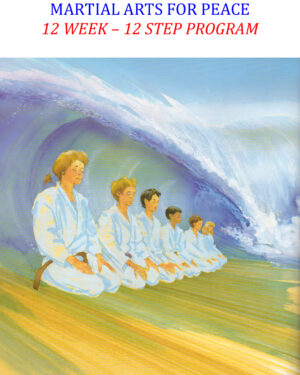
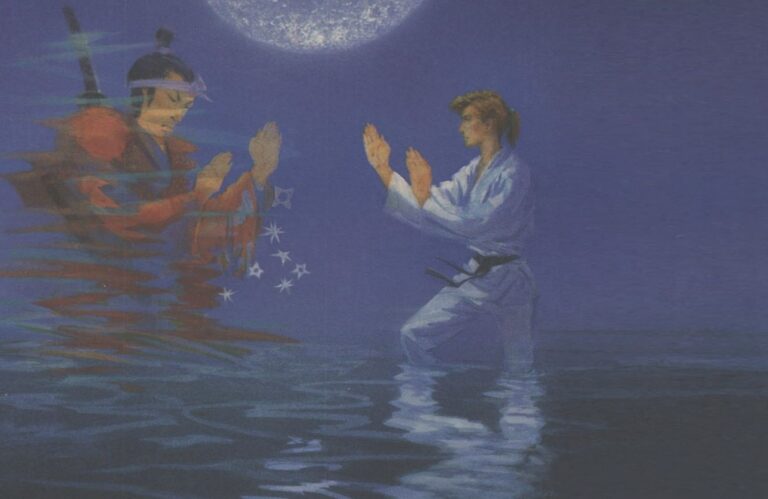
As the moon shines equally on everything, so does the mind encompass all it perceives without discrimination. In Karate when one is freestyling, if there are thoughts of winning or losing, or what technique one should use, these thoughts are like clouds that pass in front of the moon blocking the light (of awareness). So too with mind like water. Still water reflects only what is there. Thoughts are like dropping pebbles into that water, causing ripples in the mud. The distracted mind cannot respond accurately and immediately to what is happening. These concepts (mind like moon-mind like water) are important not only in the practice of Karate, in freestyling or self-defense, but are also important to one's everyday life The challenges of living demand accurate and intelligent responses. When the mind is clouded or disturbed by waves of anxious thinking, then one's response is diminished and therefore one is not capable of meeting the challenge fully. But there is more to these concepts. The word "mind" referred to in Japanese Karate means "consciousness," which is all of living. What we in the West refer to as "mind" is only a small part of this Japanese concept of mind. The typical Western notion of mind is the analytical, logical, intellect, a necessary tool for living, for creating science and technology. But "mind" in "mind like moon-mind like water" has a far deeper and more profound meaning. This mind is the foundation of all consciousness, it is consciousness aware of itself. This mind is in stillness, in silence. When the intellectual mind finds its proper place in living, in action, then this order can pave the way for the larger mind to enter. It is this larger mind from which consciousness emanates. It is where all things arise and disappear into the void. It is the seat of being, the wellspring of life. When there is a moment of forgetfulness, a stillpoint in the chaos of frenetic living, that mind may blossom. But all too often one is caught up in the smaller mind, in the frenzy of self-centered preservation, in trying to find psychological security. It is only by not knowing that one can come upon this mind. In not knowing there is intelligence. Not knowing does not mean ignorance, not thinking. Not knowing means that thought is not seeking security in itself. Mind Like Moon-Mind Like Water is a metaphor for the mind that is intelligent, a mind that is sane.


The Art of Empty Self

"Scholars of old time said that the mind is originally empty
and only because of this can it respond (resonate) to natural things without prejudices (traces left behind to influence later vision).
Only the empty mind can respond to the things of Nature.
Though everything resonates with the mind, the mind should not remain in it.
But once the mind has received (impressions of) natural things,
they tend to remain and not to disappear, thus leaving trace in the mind.
It should be like a river gorge with swans flying overhead;
the river has no desire to retain the swan,
yet the swan's passage is traced out by its shadow without any omission.
Take another example. All doings, whether beautiful or ugly,
are reflected perfectly in a mirror;
it never refuses to show anything, nor retain anything afterwards."  
    

-Ion Ching-hsi

Empty self is not a romantic term.: It is a metaphor for a mind that is not in reaction, a mind that is free of identification, of commitment psychologically. Empty self comes from understanding what fills the self up, not by forcibly trying to become empty. Becoming empty is the ideal and can therefore only cause violence in becoming what we are not. This concept of empty self is also called no mind. Empty self or no mind is a mind that is unconscious of itself; it is not disturbed by Thoughts of fears and the constant challenges of the external environment. It is a mind that is not stuck. It is a free, flowing mind, likened to a stream of water. Thoughts come, Thoughts go. This empty mindedness is not only used in the practice of Karate but applies to all activities in life. Self-consciousness impedes this flow causing an abrupt stop in consciousness. Thoughts of winning or losing, of gain or failure are all impediments because they are concerned with self, that psychological center point of reference. The empty mind is the mind of the healthy person. It sees life clearly as it is rather than how it should be. This mind focuses on the activity and not the evaluation, therefore creating a non judgmental awareness of what is. In a practical way being empty, non judgmental, one concentrates on the task at hand and one does not get thrown off by thinking that creates fear. The practice of Karate with no mind increases self-awareness and concentration, which also has benefits in one's daily life.